After the first rain
Take a short walk around to find out what recent storms have done to the area that you shall be walking through to look for wildlife.
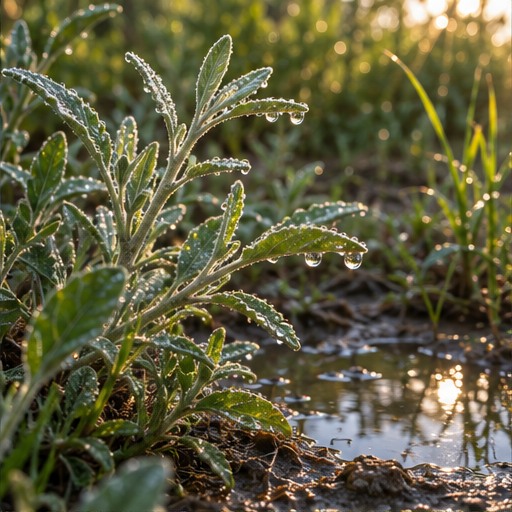
The short time effects of rain on a path are very different from the short time effects of rain on a wider landscape and can be viewed from a distance. Looking for signs of recent change on a path as part of your pre-exploration routine to check the soles of your boots, your pack and your route means that you can also look for signs of wildlife spotting in that area.
Start with the route, not the view
Wait for the storm to pass. Stay away from flooded roads, low crossings, drainage channels, and washes. Floodwater can remain hazardous after the rain stops. If a road or trail is flooded or closed, turn back.
Check for closures before you set out. On an open trail, watch for downed trees, slumped edges, and running water across the path. If the route looks unstable or water blocks the way, turn around. A familiar trail can be damaged in places you can’t see from the entrance.
Say you reach a dip where muddy water covers the path and hides the far edge. Stay on firm ground. If you can take a photo from there, you’ll have something to compare when the route is dry and open again.
Read the small channels
See where the water has collected on the path and where it has gone. Look for the smallest of channels in sandy soil made by recent flows of water. Look for where a line of leaves has ceased to grow in a shallow gouge in the soil. Look for the finest of sediments to have washed up in a stem or on a rock face and note the cleanest of lines on said rock face. Note the fan shaped deposit at the bottom of a bank where water has slowed up.
Details of interest to the very short term can easily be erased by one stray step. Binoculars or the camera's zoom will have to serve for details of interest to the very short term of interest.
Field Notes – short term details of interest that will be of no use in the long term but are of great use in the short term in order to be able to distinguish them from details of interest of a long time period and hence to be of use in relation to the question or hypothesis of interest (e.g. 'A line of leaves is running diagonally across the sandy edge of this depression. It is running down the depression from the top right to the bottom left. The surrounding ground is still wet.').
Pause where cover meets open ground
Field Notes – simple sentences which record observations against a hypothesis or question that are of interest in relation to them and which can be compared with similar observations in the future (e.g. 'A line of leaves is running diagonally across the sandy edge of this depression. It is running down the depression from the top right to the bottom left. The surrounding ground is still wet.'). Stop frequently to take in the details of interest to view for only a short time and thus of interest in order to be able to distinguish from details of interest of a long time period. Where there is cover against open ground, slow down here to take in what is before you and leave the brush alone for now. You do not know what kind of damage has occurred to the underside of a branch or to the ground behind a thicket of brush. The best route for retreat is therefore behind you along the obvious line of the path and note in particular washouts and slopes with cracks in them. Turn back here.
Some points of interest on the path will change in a short space of time (a few hours) and therefore it is best to stop frequently to view the details of interest on the route and take notes. Note points of cover against open ground. You have no idea of the damage to the underside of a branch or to the ground behind a thicket of brush. The best route for retreat is therefore behind you along the obvious line of the path. Look for washouts and slopes with cracks in them and turn back here. Field notes of interest of a short time period are of greatest interest when viewed in relation to the question or hypothesis being tested and therefore can be viewed against this later. Note in particular washouts and slopes with cracks in them.
From a firm foot-hold on the path, view animals and their signs. Do not back up from a view and be careful not to lose your camera or phone down a hole in the wet ground. Monitor the weather for sudden changes. Compare later views of animals and their signs with your field notes and photographs of the signs taken from the same viewpoint. Note the position of signs of interest in simple terms e.g. 'On the north side of the path to the marked post, near the split post'.
Use optics without trusting them blindly
Use animals and their signs from a firm foot-hold on the path. Do not back up from a view, and be careful not to lose your camera or phone down a hole in the wet ground. Monitor the weather for sudden changes. Later you can compare your views of animals and their signs with your field notes and also with photographs that you have taken of the signs. Note the position of the signs in simple terms when you return to the area e.g. 'On the north side of the path to the marked post, near the split post'.
Use animals and their signs from a firm foot-hold on the path. Never back up from a view and ensure that your camera/l_PHONE is not to fall down a hole. Monitor for sudden changes in the weather.
Later when you return to the site, compare your views of animals and their signs with your field notes. You can also compare your views with your previous photographs of the signs. In simple terms record where you found the signs when you return to site e.g. On the north side of the path to the marked post, near the split post.
Return when the ground is dry
Return to the area when the ground is dry and the path open and safe to travel on. If it is possible to return to your original observation point then it is possible to compare your old observations with the current state of the area and relate them to your photographs.
By the time you return to the area some short-term marking effects of rain on a path may have gone (disappeared). The same short-term marking effects of rain on a wider landscape may have gone (disappeared). However some longer-term marking effects of rain on a path and some longer-term marking effects of rain on a wider landscape may remain for a very long time. Note especially the following: a single leaf may have gone but a newly exposed root could remain for a very long time; a shallow pool may have gone but a slumped trail edge could remain for a very long time. Surfaces that are still undermined by hidden washout by recent rain or where water is currently flowing across them appear to be dry but are actually not safe to cross even when the surrounding ground appears to be dry. Return home.
Take all short-term marking materials with you when you leave the area and avoid leaving behind flags, food litter, etc. for a day or so. Your best field notes are those which enable the reader to know what you saw and for them to be able to compare your notes with your photos and later observations. Do not create a trail of evidence which would allow someone to follow your footsteps to the location where you had made your observations.
Keep reading
All stories
Wind notes from the prairie
Read wind in grass & write more useful notes about day.
Read more