A warm light after dusk
Create a puddle of useful light and keep the dark of night wrapped around it.
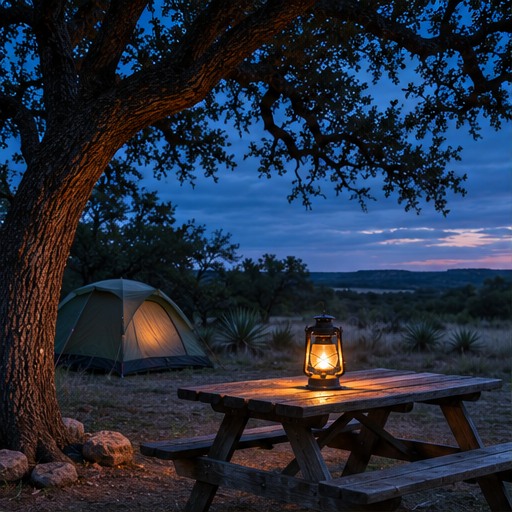
The effect that a campsite makes after dusk is that of being a place to sort through gear to locate what is needed in order to read a map, to prepare food, etc. and to find a zipper in order to put on or take off a piece of clothing. In order to locate these items in the dark of night it is necessary to have a good amount of light at the site in order to see what is in front of one. However, in order to be able to observe wildlife in the quiet of night it is best that the light not travel very far from the campsite in order to affect others.
Put the lantern beside the task
Most lanterns are best used by placing them low on the ground near the object on which you are focusing. So on a camp table it is best to place the lantern on the edge of the table nearest to you so that the light is shining down onto your work surface.
Set up the lantern so that the brightest part of the light is focused directly at the task at hand. If your lantern has a diffuser or you can set it up to be directional, use that to your advantage. Don't point the light across camp, because it can reflect off of pale tent material and annoy campers nearby.
In this example, using a lamp with a diffuser (such as a cone-shaped diffuser) and setting it to a directional setting (such as pointing at a map) would also help to keep the light where you need it and stop it from spreading all over your campsite. Finally, in terms of height, it's much better to place your light source low to the ground on a table or work surface rather than up high on a pole or in a tree where it can swing about in the wind and cast a lot of shifting shadows.
Organize your food, maps, etc. in the order you will use them before the light dies. This will make for a relatively short work time and minimize the chance that you will accidentally knock over your light while reaching in the dark.
Start dim and adjust only when needed
It's also better to start with too little light and then increase it as needed rather than starting with too much light and having to cover up the excess. This is because when you're increasing the amount of light to work with a task it's generally easier than decreasing the amount of light when the task is too bright.
Work at the light's lowest setting. If it is not readable, move the light so that it shines on the item in front of you rather than try to read it at a distance and increase the light's power. Moving a light is often easier than increasing its power.
Work under the dimmest amount of light necessary for the task at hand. Opening a package of food might require only a small amount of light, reading a long map or guidebook would require more. Checking a knot in a rope or searching for a lost item in the night might require a brief burst of light to inspect the item and then return to a lower setting for the main part of the task.
If you go outside the circle of light, look up and if you can't see the edge of the campsite, then the light has caused problems and needs to be turned down or moved. We need to make a small pool of light to work by, not illuminate the whole campsite.
Leave the work area without losing the dark
As you leave your table and head off to listen, or observe, turn down your light. It will take your eyes some time to adjust to the dark and you don't want to be traveling around the campsite feeling blind, even if the campsite itself looks much the same in the dark.
Watching from a chair or from the edge of the camp is a lot easier with dimmed light. Dimming the light will preserve your night vision longer than switching between very bright light and complete darkness. The amount of time it takes to readjust to the dark again varies from person to person and also depends on the surroundings. So avoid switching the light on and off too often unless you need to for safety reasons.
Remember that a slight decrease in light is all that is needed in order to observe. A slight increase is all that is needed in order to write. For instance, in the above hypothetical example, one would lower the lantern before looking away from the notebook, pause for a moment or two to scan the darker field of view, then raise the light just enough to write again.
Make sure you have a clear path of travel between your table and chair and your tent and gear. Night vision does not provide enough time to navigate around objects in the dark. Move bags, ropes, and cooking gear out of the way before nightfall so that you can see them in the daylight.
Keep the light from traveling farther than needed
Just because you can't see other campers does not mean they cannot see you. Keep in mind that what seems like a small amount of light to you at your camp chair can travel a long way across open spaces. Keep in mind that a small lantern on the table in front of you may appear much larger to people at neighboring campsites.
Avoid using a bright light for signaling and try not to shine it down at other people's campsites. Also try not to sweep your light around tents, cars, etc. of neighboring campers who are out to watch wildlife, to read, etc. And remember that a short task to set up camp can become a long task to keep camp illuminated when done by others in error of your intention.
As for others around you, remember that a small pool of light can make a big difference to others in the surrounding area. Have your work in front of you, and point the light down to stop it illuminating the opposite face. Work on one side of a table, rather than in the middle. The light should be directed away from people around you.
An electric lantern will have full ventilation, won't get knocked over, will not get wet or have a flammable covering get in the way of the air vents or be knocked over. Make sure a rechargeable lantern is fully recharged before heading out for the night. Store a lantern separately from food, cooking gear and such.
Make the walk back a separate decision
To go for a night time walk, to go to and from your tent, to go to and from your car, to go to and from a place to observe animals, you will require a separate light source, such as a small flashlight or headlamp.
You also want to store your backup light in the same consistent pocket every time so that when your main light is turned off you can reach for your backup in the same pocket every time.
Practice it before full dark with the main light down low, and then test to see if you can find it in the dark in the same pocket. If not then move it to another pocket where you can find it in the dark.
So in essence the purpose of a backup light is to help you avoid stepping on things in the dark. So aim the light down at the ground about 10-15m in front of you and then turn it off when you get back to camp. It serves a completely different purpose to that low close light that you used to read your maps and food packages by.
Working in this way, as I described in the previous point, separates out the uses of the light: looking at a map and eating food by a low amount of light up close to the work area; dimming the light for observation and then scanning the darker field with your eyes after you have turned away from the work area; using a very different light for walking around the campsite at night in order to avoid tripping over rocks, tent stakes, etc.
Keep reading
All stories
Shade that moves
Planning your stopover over even a short period of time can yield great rewards over mere spreading of…
Read more
The weekend gear reset
10 minutes to pack for your next quiet morning of prairie observation.
Read more